Talking points: Sinéad Goldrick
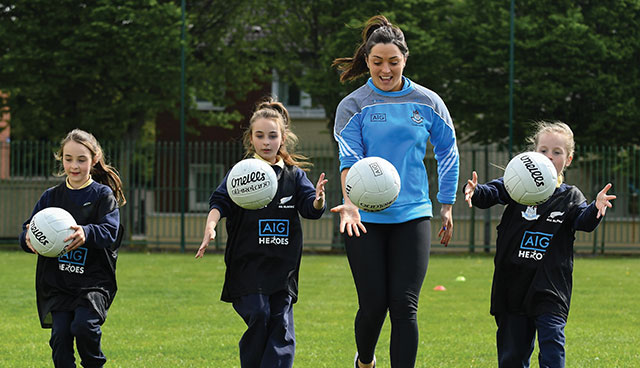
In recent years, Dublin’s Sinéad Goldrick has become one of the LGFA’s most recognisable faces. Ciarán Galway meets with the five-time All Star, All-Ireland winner and telecommunication marketing professional to discuss empowerment through sport, the omnipresent challenges and ambition.
In the face of daunting adversity, ladies Gaelic football has taken root and flourished since the Ladies’ Gaelic Football Association (LGFA) was established in 1974, 90 years after its male counterpart. While man walked on the moon before a woman played in Croke Park, the Foxrock-Cabinteely native doesn’t dwell too heavily on the significant inequalities between male and female experiences in sport.
Rather, Goldrick stresses: “I’m a huge advocate of sport and encouraging girls and young women to develop a passion for a sport that they are committed to and which brings out the best in them.” Describing sport as an enabler, she outlines: “It helps you at school, college and work. It assists in developing your personality and provides a bedrock for your self-esteem. So, it’s important that young girls can find a sport that they’re passionate about, whether that be football, camogie or whatever else.”
Discussing the potential of sport to holistically develop a young person’s skillset, Goldrick recounts her own experience. “Being a part of a group made up of all sorts of personalities with different socio-economic backgrounds, from girls in college to girls in full-time employment, helps to shape you as a person. I was 18 when I was first in the Dublin team. Playing a part in a group like that can help to improve your confidence in interacting with others and develop interpersonal skills which, can latterly be transferred into the workplace.”
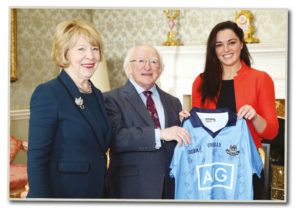
Gender inequality
Recognising that gender inequality is “an issue across all sports”, Goldrick is keen to emphasise the progress and improved standards in relation to training and access to facilities within the Dublin county structures. “That’s an area in which I’ve seen a huge change. We didn’t have the resources we have now even as recently as five or six years ago. The set-up now is something that I’m proud of because there was a time when we didn’t have suitable training facilities. Things are progressing.”
Speaking with admiration at the way in which the FAI women’s team spoke out earlier this year to highlight the inequalities they were experiencing, Goldrick notes: “I have huge respect for that and the manner which they drew attention to their concerns. The FAI ladies’ team stood up and I suppose if other teams aren’t happy with the standards then they need to look at that episode as an example, stand up and demand that their basic expectations are met.”
The Dublin half-back also praises her manager Mick Bohan and his predecessor Greg McGonigle. “They went to the County Board on our behalf and demanded that standards were raised. So, there are professional and dignified methods of ensuring that.”
Player retention
Beyond early involvement, player participation is difficult to maintain into adulthood for a myriad of factors, not least because of the degree of time commitment required from participants.
Acknowledging that significant improvements are being made within ladies’ Gaelic football, Goldrick identifies three core components in assisting player retention. Firstly, “With the LGFA providing increased coaching opportunities, the onus is on today’s managers to upskill themselves. When you’re dealing with any young people, in both male and female sport, managers and coaches need to have the skills which facilitate a high level of participation and enjoyment for players.”
Secondly, “The improved standards of the games, the pitches and resource provision has gone some way in ensuring that players feel valued.”
Finally, “It’s important that parents are conscious of avoiding placing too much pressure on their children. I was very lucky in that my mum and dad didn’t do that and my involvement in sport felt like an independent choice. There is also an onus on parents and guardians to bring their children to ladies’ games if they show an interest in the sport.”

“I’m a huge advocate of sport and encouraging girls and young women to develop a passion for a sport that they are committed to and which brings out the best in them.”
Challenges
At the same time, Goldrick concedes that there is still work to be done, with media coverage one obstacle that she explicitly highlights.
“From a media perspective, there is a contention that the volume of columns and coverage in is proportion to interest and demand. But, as things stand, the coverage is not where we want it to be. The more that journalists engage with the stories and acknowledge the history, the background and the rivalries of the teams involved in the sport then the more that interest will grow.
“There are 170,000 members of the LGFA which gives some indication of the interest that is out there. I think it’s important for players to tell their stories from their perspective. With enhanced media coverage and heightened awareness, attendance should rise in correlation and subsequently the sponsorship deals will come. Sponsors are playing a huge role in energising and promoting our story.”
Arguing the case for enhanced cooperation between the LGFA and the GAA, Goldrick suggests the increased implementation of double headers ahead of the men’s games as a simple and immediate improvement. “We played Mayo for the first time ever in a League match ahead of the men’s Dublin versus Westmeath game and examples like that showcase our game. In terms of progress, I’m optimistic about those developments.
“It’s about the associations working together and I completely understand that there can be close to full attendance at men’s Championship games, but when I look at the League there is plenty of scope for a realistic implementation of double headers.”
Importance of the LGFA
While Goldrick played a range of different sports from a young age, including basketball and athletics, she maintains that “the people” proved to be the biggest factor in attracting her to ladies’ football. This manifested itself in friendship and camaraderie: “Through being involved with Dublin I’ve been able to make friends with people from all over the city, which I definitely wouldn’t have had the opportunity to do unless I played the sport. Again, I’ve been playing with some of them since under-14 and all the way up to senior.
“My family are also really invested in the sport and my dad has been to every single game of mine since I was younger and has driven me all around the country. I really enjoy it and I’m proud to play for both Dublin and my club [Foxrock-Cabinteely].”
Commitment
Goldrick welcomes the increased professionalisation and commitments of the sport. “As a representative of your county, you want to fulfil that role as best as you can. If you want to maintain a high level of ability, then you need to engage with all aspects of performance improvement.
“We would train four or five times a week and then on top of that I would be playing with my club. Strength and conditioning is something that has really evolved as a core component of the game and I’ve really seen a huge emphasis on the importance of nutrition.”
Praising Mayo’s Cora Staunton as “a legend of the sport who can get scores from any angle”, and likewise, Dublin’s Sinéad Ahern as “one of the best forwards that I know”, Goldrick suggests: “Ambassadors like these, all over the county and indeed the country can really showcase the game. I think the sport in general is progressing in standard as the professional elements become embedded.”
Sponsorship deals
The significant sponsorship deals which are now filtering into ladies’ Gaelic football have in no small part played a significant role in ensuring an enhanced awareness of the sport. Examples such as the substantial advertising hoarding on the Jones’ Road railway bridge, featuring several LGFA players, including Goldrick, are now increasingly commonplace and visually characterise the sport’s resurgence.
“There has been a noticeable uptake in interest since the significant sponsorship deals secured by the LGFA in recent years,” Goldrick asserts. “Anecdotally for instance, people in work would be aware of the games that are coming up and will ask about our progress which wouldn’t have previously happened. To have the two highest attendances at the LGFA finals, which were also the highest in Europe for a ladies’ football match, highlights that the noise being made by sponsors is having a tangible and welcome impact. TG4 viewership for games is rising every single year highlighting again that there is an interest.”
Social media too has been a facilitator of interest, enabling the instantaneous transmission of fixtures and results. “Previously it would have been more difficult to access that information and I think that county boards could be doing more to engage with this as method of bringing attention to the sport.
“I am optimistic and can really see the game improving holistically. In 10 years, we may see even bigger spectacles with much higher attendances and it makes me jealous because I’ll no longer be playing. People are tuning in or attending, but we need to encourage this beyond the all-Ireland semi-finals and finals.”
Ambitions
Goldrick shares a dream with many in the LGFA to see the sport recognised through attendances which are on par with the men’s game. “There is obviously a huge gap between when the GAA formed and when the LGFA formed and subsequent development, but I would love to see that dream realised with up to 30,000 people at a ladies’ game and full attendance at All-Ireland final stages. The commitment and the skillset of the players is already in place and on display so we just need people to start coming and watching in great numbers.
“A key message I’d like to get across would be to encourage parents to take both their sons and daughters to ladies’ Gaelic games, whether that be at the local club or to an intercounty fixture. I think that’s really important in order to establish a recognition and an awareness of the ladies’ game. For a young girl growing up showing an interest in sport, it’s so important that parents encourage involvement while also ensuring enough space for the passion to grow organically.”
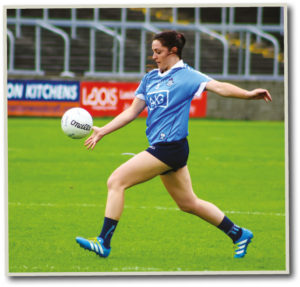
The telecommunication marketing professional also has aspirations of her own, more specifically to win a club and a county All-Ireland. “Either of them would mean just as much to me. That’s our aim and ambition every single year and I would just hope that one day we get to that point.”
Goldrick regards reaching the All-Ireland Championship Final with her club as one of her greatest sporting accomplishments so far. “Our club is very young. It’s solely a ladies’ football club. We don’t have a bar or anything like that. It’s just a pitch out in Cabinteely and for us to get to the senior All-Ireland final was a massive achievement.” She also recollects the privilege of playing in Croke Park for the first time three years ago, as the then Dublin captain. “I got to bring my niece out on the pitch with me which was a really special experience.”
Closing the interview, Goldrick remarks: “Unfortunately, we haven’t got the result we want yet, but if I was given the opportunity again, knowing we would still have lost, I would still go through with it. Even though it wasn’t our ultimate goal, and I know this sounds clichéd, it is part of the journey.”
Following her interview with eolas, and though injured for most of the season, Goldrick made it over the line when the Dubs brought an abrupt end to their All-Ireland Final losing streak by demolishing Mayo in front of a record 46,286 crowd, playing an integral role from wing-back.