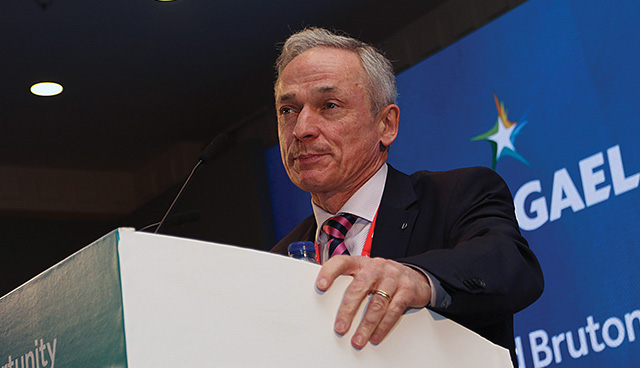
 STEM teacher supply. Skills shortages. Shifting demographics. The Baptism barrier. Ambitious Action Plan objectives. Ciarán Galway speaks with Education Minister Richard Bruton amidst a testing time for Irish education.
Reflecting on his time in the portfolio, Minister for Education Richard Bruton contends that there have been a number of significant achievements.
Under his Department’s three-year Action Plan (2016 to 2019) a total of 6,000 extra teachers and 3,000 special needs assistants are set to be employed. “That has really made a difference to the learning environment,” he says.
“There has been a huge improvement in the performance of Irish students in literacy and numeracy. That is a real indicator that we’re going in the right direction in terms of outcomes and that we’re also making investments in critical areas.”
In terms of disadvantage, there are fewer students dropping out of Delivering Equality of Opportunity in Schools (DEIS) than ever before alongside a 32 per cent increase in the number of people progressing from disadvantaged backgrounds into third-level. The Minister suggests this indicates that “we are catching disadvantage”.
“For children with special needs we have also rolled out a new approach that no longer requires a child with special needs to have a diagnosis, a badge on their back, to get access to support. That has been really welcomed in the schools as having an impact.
“On the wider interface between education and the world of work, we have 59 new apprenticeships in the pipeline, we are rolling out the technological university legislation which will see new drivers of skills in the regions. We’re putting investment in behind that – we have a €200 million PPP package of investment in institutes of technology,” he details.
Best in Europe
In February, the second annual plan within the Action Plan for Education Framework 2016-2019 was published. Identifying education as “the heart of all our ambitions as a nation”, the latest plan asserts that 86 per cent of the actions targeted for the end of 2017 were delivered and outlines an additional 370 actions and sub actions for 2018.
The Department’s overall ambition is to establish Ireland’s education and training system as ‘the best’ in Europe by 2026. According to the Action Plan, this means:
• delivering a learning experience to the highest international standards;
• breaking down the barriers of educational exclusion to set a benchmark for social inclusion;
• equipping all learners to succeed in a changing world;
• leading in innovation; and
• building a bridge between education, enterprise and the wider community.
The way to measure progress against these five goals, Bruton explains, is to focus on outcomes. “We measure outcomes in each of those areas. We are also looking at the policy tools which will drive us on. For example, we have restored guidance counselling, we are investing in wellbeing programmes and we are investing in senior cycle computer science and PE. This drags investment into the areas we want to make an impact.
“One of the big themes that I am trying to drive is the concept of innovation. We will have innovative school clusters in Gaeltacht areas, in digital, between DEIS schools and between schools providing speech and language therapy within the education system.”
These clusters, supported under the School Excellence Fund, are aimed at encouraging talented leaders within education to maximise their impact, not only in their own schools, but beyond.
Admissions policy
Having previously been critical of existing admissions rules for oversubscribed schools, commonly referred to as ‘the baptism barrier’, forthcoming Government legislation will ban waiting lists which, Bruton states, “has been a source of unfairness”.
“We are also moving to remove religion as a criterion for selection from the vast majority of schools so that people won’t feel that someone from a distant location will get preference in a local school because they happen to be of a particular religious background. For the minority religions, which represent around 5 per cent, we will ensure that they get that access,” Bruton outlines.
“As I have said, we are investing in the teaching profession. There has been a lot of focus on pay. We have significantly restored pay, however, people haven’t noticed that. Not only does a teacher now start on €36,000 straight out of college, but in the last two years I have created 3,000 posts of promotion.”
“Schools have a responsibility to accommodate and be open to all children. If they are not honouring that, we are also legislating for the power to designate a school to facilitate a child with SEN,” he adds.
Teacher supply
The Education Minister takes exception to the suggestion that schools are having difficulty in attracting qualified teachers to fill STEM and language posts. “I think the first thing to say is that there aren’t problems in filling posts. We have already employed 5,000 extra teachers and there are 3,000 teachers graduating each year,” he maintains.
“We’ve recognised in the last two years, is that we have picked up most of those through permanent positions and this has created some pressure for substitution, but there hasn’t been a problem with either recruitment or with the flow of new teaching graduates. We have significant new ambitions for STEM and for foreign languages. In those particular areas, we will need to see enhanced recruitment, so we are looking at measures to incentivise people to come into the profession, especially those who have physics, biology, chemistry, home economics and various pinch point subjects.”
Suggesting that, up until now, there has been “a fairly laissez faire attitude” to the subject specialisms initially chosen by trainee teachers upon course entry, Bruton outlines: “We will be a little bit more focused in where those 3,000 should come from in the future.”
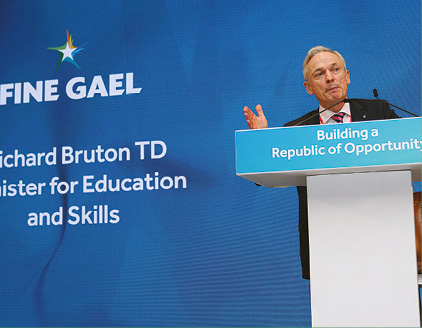
One measure aimed at achieving this is incentivisation aimed at delivery in these ‘pinch points’. When asked if this indicated the introduction of quotas for undergraduate and postgraduate teacher training course numbers in particular subject areas, Bruton states: “It would mean, if we need to see an extra 5 per cent of people doing STEM subjects, then we would take steps to create an expansion in those programmes at the cost of areas where we are plentiful.
“As I have said, we are investing in the teaching profession. There has been a lot of focus on pay. We have significantly restored pay, however, people haven’t noticed that. Not only does a teacher now start on €36,000 straight out of college, but in the last two years I have created 3,000 posts of promotion. We are making significant investment and moving away from seniority being the basis for promotion and investing in the support of leaders through the Centre for School Leadership. I’m very keen to see a strengthened middle management because the quality of the teacher and the quality of the leadership in the school is what really shifts the dial in terms of how a child performs.”
Overall, while conceding that ‘pinch points’ in the teaching supply, the Minister’s central tenet is that “it remains a very good profession and I’m very ambitious for teaching to modernise itself, apply new digital technologies and a good many exciting things are happening in the teaching world at the moment”.
New entrants
While acknowledging that teachers’ unions regard the wage gap between those employed before and after January 2011 as “unfinished business”, Bruton emphasises his budgetary strains. “I suppose for a government, we have to balance different demands. I’ve had to invest in new teachers, in special education and all those items I’ve mentioned earlier and I have to balance that against the legitimate demand for extra pay.
“The recent pay agreement set out €900 million to be paid over the next three years and everyone right across the public service will get that. That process is now underway and all the teachers’ unions are engaged with it. This other issue of the new entrants is one that will be a longer-term issue for government to decide what money is committed. Money hasn’t been assigned to it at this point, but that is a work in progress.”
Apprenticeships
In pursuing a greater link between education and enterprise, apprenticeships are set play a crucial role. The Minister outlines plans to treble the number of apprenticeships and double the number of traineeships in order to provide entirely new alternative pathways for young people to reach their learning potential.
“In practical terms, this is what ‘the republic of opportunity’, as the Taoiseach refers to, is about. That means opening new pathways for people to get to success in a changing world. There are real opportunities for apprenticeships, including 59 entirely new trades coming on stream which will encompass insurance, data protection, computer animation and many more right across the employment spectrum. There are so many new areas where we can develop the earn-as-you-learn model and embed learning in a practical enterprise environment, alongside college,” he explains.
Currently, record numbers are enrolled in third-level education, while, as Bruton asserts, apprenticeships have become unappreciated in Ireland. “Obviously, we don’t have the culture which exists in places like Germany and Austria in terms of guilds and employers embedded in learning as part of a social partnership. So, we have had to create it.
“We are going through the process of building coalitions of employers to commit to the apprenticeship journey. We are really excited about that and it will dramatically improve things. Employers can nurture the skills required in their own area and know that a particular individual is work-ready because they are already observed for two or three days a week. Simultaneously, the student doesn’t have to pay upfront for their education. They are getting a quality certificate, which is a passport for them to travel on this journey. It is a really exciting trajectory that has been undervalued in Ireland.”
Technological universities
The Government is committed to the establishment of amalgamated and augmented institutes of technology in the form of technological universities. Responding to a query on the rationale for such developments, the Minister emphasises the wider economic health of the nation.
“Balanced regional development is the key. We’ve grown our employment base by 240,000 since the depths of the crash and we are seeing a good regional spread, but to make that sustainable, we must have deeper talent bases in each of the regions, to ensure that they can retain their own talent, support existing companies and nurture new companies,” he unpacks.
“If we’re to have balanced regional development, we need deep skill pools that can be a magnet to foreign direct investment. We need to develop the applied research capability, to work with industries and the sectoral strengths of regions to build those companies up. The idea has been that we need bigger scales, that we need merger and we need coherence in those regions.
“We will create state of the art facilities that not only provide the chance for people to be trained in their own region. When you have an IDA supported company, or indeed an Irish company that wants to expand, they will look at the skill base that we have built around the technological universities and see that as a real asset for them to grow.”
Funding models
Delivering in further and higher education requires significant investment. The Government has committed additional exchequer money and raised the National Training Fund levy by 0.1 per cent in three incremental annual phases from 0.7 per cent in 2017 to 1 per cent by 2020.
The Minister contends that a “more dramatic change” is occurring in capital investment. “We did have an investment programme of €110 million for the next four years and that has now gone up to €367 million. It represents a very significant step up in the level of investment we can make in the education facilities for the future.
“We will be looking at those exemplars of good practice and, while not trying to imitate them word for word, because you can’t simply plant German culture in Irish soil and expect it to grow, we will take the things which are relevant to Ireland and apply them here.”
“The third piece of the jigsaw is that we have now reformed the way in which money is allocated to colleges in order to incentivise the sort of changes we need: meeting the skills gap, encouraging more innovation, reducing dropout rates, attracting people from disadvantaged backgrounds and embedding with local enterprises,” he says.
However, the Minister does not dismiss the introduction of a student loans system. “The proposal that came from Peter Cassells wasn’t a UK-style model, I think it was more likened to an Australian model, but it was a student loan and the idea was that students would move away from upfront fees to this income contingent loan, that they would pay after they qualify.
“That has gone to the Oireachtas Committee because, as I have said very clearly, there needs to be political consensus around such a significant change in the way students contribute towards their education. The Oireachtas Committee is still to come back to me with their report, so I know that there is considerable opposition being put forward. In the meantime, we are certainly not sitting on our hands, we are investing through the other mechanisms that Cassells advocated: more exchequer money and increased contribution from employers.”
The future
Looking to the future, Minister Bruton concludes: “The merit of the action plan is that we’ve set a long-term goal, a 2026 goal, nine years away, to be the best in Europe. We know what that means. We are already best in significant areas. Our ten-year-olds are the best in literacy and maths in Europe.
“We have set goals in all areas: creating a better learning environment, better at dealing with disadvantage, better at building links to the wider world and better at creating continuous improvement. We are investing in all of those, so I will be looking to improved outcomes in each of those areas.
“That’s where the ambition is. We will benchmark ourselves against whoever is best in the field and we’re setting up a strategic policy unit within the Department to do that in-depth work. We will be looking at those exemplars of good practice and, while not trying to imitate them word for word, because you can’t simply plant German culture in Irish soil and expect it to grow, we will take the things which are relevant to Ireland and apply them here. It’s a really exciting programme.”